


Sterling silver cutlery hallmarks are the tiny, stamped symbols that guarantee a piece's silver purity, where it's from, and how old it is. Think of them as a historical fingerprint, telling you who made it, where it was certified, and exactly when—a crucial mark of quality for any collector.
Your Silverware Is Telling a Story

Every fork, spoon, and knife in a sterling silver set holds a secret language, stamped right into the metal. These little symbols are far more than just decoration; they're a direct message from the past. You could almost call them your silverware's birth certificate, holding a rich story that's just waiting to be read.
This guide is here to turn those confusing stamps from a mystery into a clear, fascinating story. We’ll explore why understanding these marks is so vital for any collector, transforming a beautiful object into a documented piece of history.
Why Hallmarks Are Essential
Learning to read sterling flatware hallmarks is the key to unlocking the true history and worth of each item. It offers insights that go far beyond what you can see on the surface. For anyone serious about silver, this knowledge isn't just nice to have—it's indispensable.
Here's why these marks are so important:
- Authenticity Guarantee: Hallmarks are your best friend for verifying that a piece is genuine sterling silver (which is 92.5% pure silver) and not a less valuable silver plate or another base metal.
- Historical Context: With these marks, you can pinpoint the maker, the city where it was tested, and often the exact year it was made. Suddenly, your cutlery is connected to a specific time and place.
- Valuation: The story revealed by hallmarks—like the age, maker, and origin—directly impacts an item's value. A piece by a famous silversmith like Paul Storr, for instance, will be valued far higher than an unmarked equivalent.
- Deeper Appreciation: When you know the story behind your silverware, it fosters a much deeper connection. Your cutlery is no longer just a set of utensils; it becomes a treasured heirloom with a real link to the past.
A hallmark is more than just a stamp; it's a centuries-old promise of quality. It represents a system of consumer protection that has been around for over 700 years, making sure every piece meets a rigorous, legally defined standard.
Whether you've inherited a family set of sterling silver cutlery or are just starting your collection, mastering the language of hallmarks unlocks both a deeper appreciation and tangible value. This guide will give you the foundational skills you need, turning you from a casual owner into a confident and informed collector.
How to Read a British Silver Hallmark
At first glance, a British hallmark might look like a jumble of tiny, random symbols stamped into the metal. But once you know the system, those little marks transform into a story—a guarantee of quality that’s over 700 years old. Think of it as a 'silver passport', where each stamp tells a vital part of the piece's history, from its purity to its origin.
This system might seem complicated, but it's actually a beautifully logical language. We'll break down the four essential components you’ll find on most British sterling flatware. By the end, you'll be able to turn that cluster of symbols into a readable history.
Let's start by looking at the four main characters in this story. This table gives you a quick overview of what each mark means before we dive into the details.
The Four Key Components of a British Hallmark
| Hallmark Component | What It Tells You | Common Example (Symbol) |
|---|---|---|
| Standard Mark | Guarantees the silver purity (92.5%). | The Lion Passant (a walking lion). |
| Assay Office Mark | Shows which city tested and marked the item. | A Leopard's Head (for London). |
| Date Letter | Pinpoints the exact year of hallmarking. | A letter in a specific font and shield. |
| Maker's Mark | Identifies the silversmith or workshop. | A set of initials, e.g., 'P.S'. |
Now that you have the big picture, let's explore what each of these marks really tells us.
The Standard Mark: Your Guarantee of Purity
The first and most important symbol to find is the Standard Mark. This is your absolute guarantee of silver content. On British sterling, this is almost always the iconic Lion Passant—a walking lion in profile.
Seeing that lion confirms the piece meets the sterling standard, meaning it’s made from an alloy of 92.5% pure silver and 7.5% other metals for strength. It's an unwavering promise of quality, a tradition that has protected buyers for centuries.
The British hallmarking system is an incredible legacy of consumer protection. It all started back in 1158 when King Henry II first set the 92.5% silver standard, a perfect ratio for creating items that were both beautiful and strong enough for everyday use. This was formally made law in 1300 by Edward I, creating a testing system that has continued ever since, making British silver some of the most trusted in the world. You can read more about this 700-year legacy of quality control to appreciate its historical importance.
The Assay Office Mark: Pinpointing the Location
Next up is the Assay Office Mark, which is like a city stamp. This symbol tells you exactly where the item was officially tested and certified for its silver purity. Each major British city with an assay office has its own unique, historic mark.
Learning to recognise these marks is like becoming a historical geographer of silver. It connects your fork or spoon to a specific place with a rich silversmithing heritage.
Here are the most common Assay Office marks you’ll come across:
- London: A leopard's head (it had a crown until 1822, but has been uncrowned since).
- Birmingham: An anchor.
- Sheffield: A crown (until 1974), which was then replaced by a Yorkshire Rose.
- Edinburgh: A three-turreted castle.

A British hallmark isn't just a set of symbols; it's a legal document stamped in metal. Each mark is compulsory and provides a level of traceability and assurance that is unparalleled in the world of antiques and collectibles.
The Date Letter: A Code Through Time
The Date Letter is perhaps the most fascinating part of the hallmark puzzle. This single letter, presented in a specific font, case (upper or lower), and shield shape, pinpoints the exact year the piece was hallmarked. It’s a time-travelling code that lets you date your silver with incredible accuracy.

Each assay office ran its own cycle of date letters, changing them annually. For instance, a lowercase 'a' in a square shield from the London office means a different year to the same letter from Birmingham. This is precisely why you need to identify the Assay Office Mark first before you can crack the date code.
The Maker's Mark: The Silversmith's Signature
Finally, we have the Maker's Mark (or Sponsor's Mark). This is the personal signature of the silversmith, workshop, or company responsible for the piece. It’s usually a set of initials enclosed within a shaped outline.
This mark connects a piece of flatware back to a human creator. Researching a maker's mark can open up a whole world of discovery, revealing the history of a specific artisan or a renowned firm like those whose pieces are curated at Lincoln House Cutlery. It’s the final piece of the story, giving credit to the skilled hands that crafted your beautiful silver.
Watch this short video for even more information on identifying silver hallmarks:
Decoding Assay Offices and Date Letters
Once you’ve got a handle on the four key parts of a hallmark, you can start to place your silver in a specific time and location. The Assay Office Mark is your geographical pin, and the Date Letter is a tiny time capsule. Getting to grips with these two is how a collector goes from simply admiring a piece to becoming its historian, uncovering the exact story of where and when it was made.
Think of the Assay Office mark as the piece’s birth certificate. For centuries, Great Britain has had several official testing centres, and each one has its own distinct, historic symbol. Learning to recognise these is the first step in tracing your flatware's journey.
The visual language of these symbols is steeped in history, evolving ever since King Edward I first introduced the leopard's head mark way back in 1300. At first, this single mark was enough to guarantee purity, but by 1336, a maker's mark and date letter were added to the mix. The famous Lion Passant joined in 1544, creating the foundation of the system we still recognise today.
These historical tweaks are fantastic clues for dating. For example, the crown was removed from the London leopard's head in 1822, instantly telling you if a piece is older or younger than that year. Today, the main offices—London, Birmingham, Sheffield, and Edinburgh—each use their own mark, letting you know exactly where a piece was certified. You can explore a deeper history of these changes in British hallmarking to really understand their significance.
This timeline shows just how these foundational moments in British hallmarking unfolded, progressing from a single royal stamp to a much more detailed system.
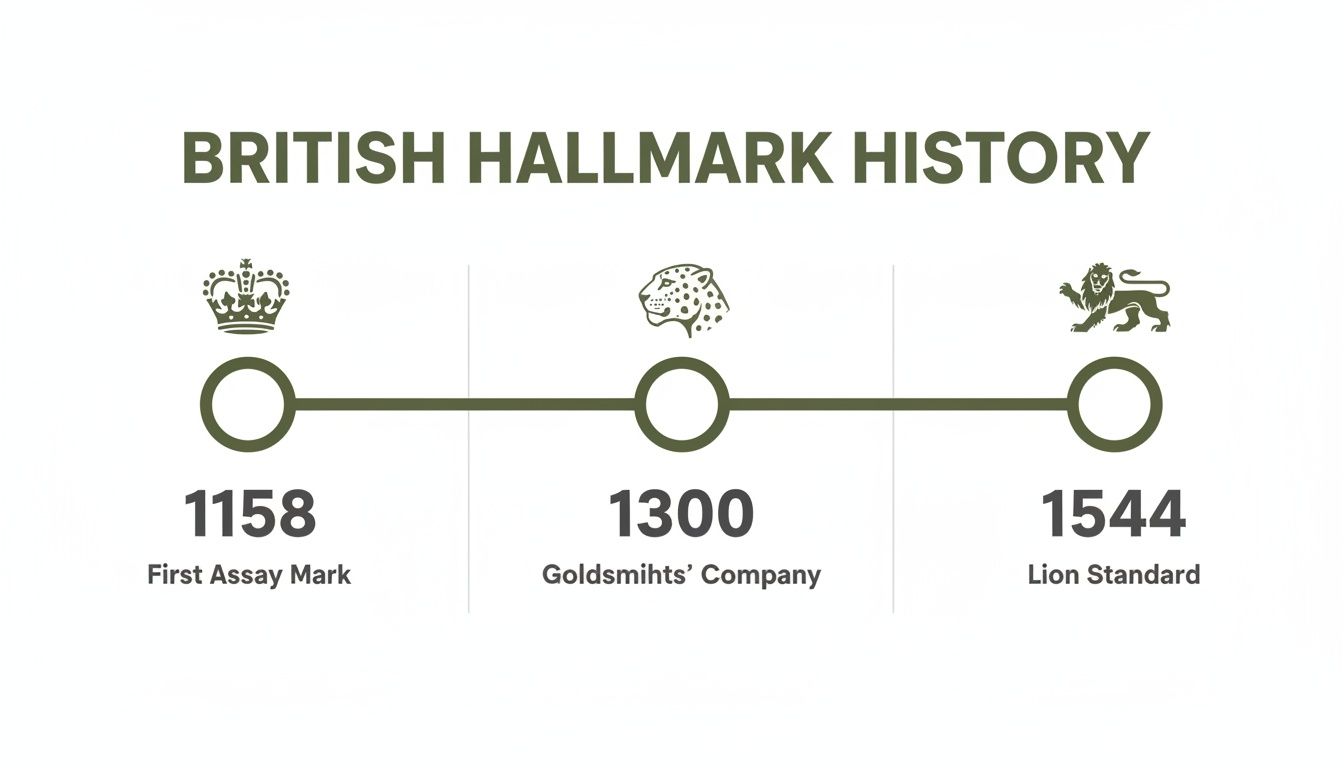
As you can see, the core components we rely on today—purity, location, and date—were established centuries ago and remain absolutely central to authenticating sterling flatware.
Identifying the Main UK Assay Offices
While dozens of assay offices have popped up over the centuries, four have truly dominated British silver production. If you can familiarise yourself with their marks, you're well on your way. You'll encounter these symbols far more than any others on antique flatware.
- The London Assay Office: Its mark is a leopard's head. Here’s a crucial tip: this leopard was crowned until 1822 and has been uncrowned since. It’s an immediate and vital clue for dating pieces from this period.
- The Birmingham Assay Office: This office uses an anchor as its symbol. Established in 1773, its mark is commonly found on pieces from the industrial heartland of England.
- The Sheffield Assay Office: Originally marked with a crown (until 1974), Sheffield later adopted the Yorkshire Rose. Seeing that crown instantly tells you the piece predates the mid-1970s.
- The Edinburgh Assay Office: A proud three-turreted castle represents items assayed in Scotland's capital, a mark that’s been in continuous use since the 15th century.
The Art of Reading Date Letters
After you’ve figured out the Assay Office, you can get to the most rewarding puzzle of all: the Date Letter. This clever system pinpoints the exact year an item was hallmarked. But it's not as simple as 'A' for year one and 'B' for year two; the system is far more intricate than that.
Each assay office ran its own distinct cycle of letters. The letter's appearance—its font, whether it's upper or lower case, and the shape of the shield or ‘cartouche’ it sits in—all change with each new cycle. This means a lowercase 'k' in a square shield from London is from a completely different year than a lowercase 'k' in a circular shield from the very same office.
A date letter is the most precise tool a collector has. When combined with the Assay Office mark and other clues, it allows you to connect a piece of silver to a single, specific year in history.
To date a piece accurately, you need a clear process. Don't just guess!
- Identify the Assay Office First: This is non-negotiable. You can’t correctly interpret the date letter without knowing which city's chart to consult. Is it a leopard's head (London) or an anchor (Birmingham)?
- Observe the Letter and Its Shield: Look really closely at the details. Is the letter a fancy gothic script or a simple block font? Is the shield it sits in squared-off, pointed at the bottom, or rounded?
- Consult a Reference Chart: Use a reliable online date letter chart or a good hallmark book. Carefully match the Assay Office symbol, the letter itself, and its shield shape to find the corresponding year.

This methodical approach takes all the guesswork out of reading sterling flatware hallmarks. It transforms what looks like a confusing cluster of tiny stamps into a clear, verifiable date, adding immense historical context and value to your collection.
Identifying Hallmarks Beyond Great Britain
While the British hallmarking system is remarkably thorough, the world of silver is a big one. As you start exploring pieces from outside the UK, you’ll discover that different countries came up with their own methods for marking purity and origin. Stepping into this wider world means learning a new set of clues, but it opens up a wealth of beautiful international designs.
Many countries took a more direct approach than Britain's complex system of symbols and date letters. Instead of looking for a Lion Passant, you'll often find simple numbers stamped straight onto the silver. These numbers tell you the silver purity in parts per thousand.
This means a piece marked '925' is the direct equivalent of British sterling, as it contains 92.5% pure silver. This is now the most widely recognised international standard.
Key International Silver Marks
Once you start looking at continental European and American silver, you'll encounter a completely different visual language. You’ll be looking for different symbols and numbers instead of a lion or an anchor. Getting to grips with these is essential for any collector wanting to build a diverse collection.
Here are a few of the most common international marks to look for:
- France: Keep an eye out for the Minerva head mark. Enclosed in an octagonal frame, this symbol has been used since 1838 to guarantee a minimum silver purity of .950 (95% silver)—that's even higher than the sterling standard! A smaller Minerva head in a rectangular frame indicates .800 silver (80% silver).
- Germany: After 1886, German silver was often stamped with a crescent moon and crown ('Halbmond und Krone'). You'll usually find this national mark alongside a numerical purity stamp, like '800' or '925'.
- Denmark: Famous for its sleek modernist design, Danish silver is frequently marked with three towers, the symbol of Copenhagen. This is often accompanied by the last two digits of the year and a maker's mark, such as that of the legendary Georg Jensen.
Many European countries, particularly Germany, Italy, and the Netherlands, widely used the '800' standard. Although it's not sterling, 800-grade silver is still a high-quality precious metal alloy. Recognising this mark is key to accurately assessing a piece's true value and composition.
Understanding American Silver Marks
The United States went down a different path entirely. With no government-run assay office system, American silversmiths had to rely on their own reputation and branding. The responsibility for guaranteeing silver quality fell squarely on the manufacturer's shoulders.
This created a maker-centric system where the company name or maker's mark is the most important feature. Iconic brands built their legacy on trust, stamping their pieces with marks that became a byword for quality.
When you're looking at American flatware, you should look for:
- The word "Sterling": This is your clearest indicator. American law required that pieces sold as sterling had to be explicitly marked as such.
- The numerical mark "925": Sometimes you'll find this used alongside or instead of the word "Sterling."
- A prominent maker's mark: This is the key to identification. Recognising these will help you spot some of the most collected American patterns.
Well-known American makers include:
- Gorham: Often represented by a lion, an anchor, and the letter 'G'.
- Tiffany & Co.: Their name is their mark—a powerful brand guarantee in itself.
- Reed & Barton: Known for various marks, often including an eagle or a lion.
- International Silver Co.: Look for the letters 'IS', a hallmark representing one of America's largest silver manufacturers.
By familiarising yourself with these key international sterling flatware hallmarks, you can confidently identify pieces from across Europe and America, adding a rich, global dimension to your collection.
How to Properly Examine Your Hallmarks

Knowing the theory behind sterling flatware hallmarks is one thing, but actually putting that knowledge to use is another skill entirely. This is where you graduate from student to detective, learning to inspect these tiny marks with a professional’s eye. It takes the right tools, good lighting, and a clear idea of what you’re looking for.
The Right Tools for the Job
Your most essential piece of kit is a jeweller's loupe. A standard magnifying glass is better than nothing, but a loupe with 10x magnification is the industry standard for good reason. It’s powerful enough to reveal the finest details—like the cut of a shield or the serifs on a date letter—without distorting the image.
Good lighting is just as critical. A bright, direct light, like an adjustable LED desk lamp, will help illuminate every nook and cranny of the stamp. Try angling the light across the hallmark; this simple trick casts subtle shadows that accentuate the three-dimensional depth of the stamp, making it much easier to read.
Getting the Marks Ready for Inspection
Decades of polishing and use can leave dirt and tarnish packed into the tiny impressions of a hallmark, obscuring the very details you need to see. A gentle clean is often necessary, but it has to be done carefully to avoid damaging the silver.
Never, ever use abrasive polishes or harsh chemicals directly on the marks. Instead, start with a simpler approach:
- Grab a very soft-bristled brush (an old toothbrush is perfect) and dip it in warm, soapy water.
- Gently scrub the hallmarked area in a small circular motion to lift out any grime.
- Rinse the area well and dry it straight away with a soft, lint-free cloth to prevent water spots.
If you’re dealing with stubborn tarnish, a gentle rub with a silver polishing cloth should do the trick. The goal here is just to improve legibility without wearing down the sharp edges of the marks, which are crucial for authentication.
A genuine hallmark is a crisp, sharp impression struck into the metal with a steel punch. The edges should be well-defined, not soft or blurry. This physical characteristic is one of the most reliable indicators of authenticity.
Spotting Forged or Altered Hallmarks
Unfortunately, where there’s value, there are often fakes. Learning to spot the red flags of a forged or altered hallmark is a vital skill for any serious collector. A dodgy mark can turn what looks like a valuable antique into a piece that’s practically worthless.
The most common giveaway of a forgery is a soft, indistinct look. Real hallmarks are punched into the silver, creating sharp, defined edges. Forgeries, on the other hand, are often cast along with the piece or electrotyped, resulting in blurry, rounded edges that just don't have the crispness of a genuine strike.
To help you tell the difference, here’s a quick comparison of what to look for.
Spotting Authentic vs. Forged Hallmarks
| Characteristic | Authentic Hallmark | Potential Forgery |
|---|---|---|
| Edge Definition | Sharp, crisp, and well-defined edges from a steel punch. | Soft, blurry, or rounded edges, often looking "melted." |
| Consistency | Marks are uniform in depth and style, consistent with the era. | Inconsistent depth, incorrect symbols for the period. |
| Wear Pattern | Wear is consistent with the rest of the piece's surface. | Marks appear pristine on an otherwise worn item. |
| Placement | Placed logically and evenly, often in a straight line. | Crooked, unevenly spaced, or in an illogical location. |
Always be sure to cross-reference the entire set of marks on a piece. A forger might get one symbol right but slip up by using a date letter from the wrong cycle or an incorrect shield shape for that town’s assay office. By carefully checking every detail with your loupe and comparing it against reliable reference charts, you’ll build the confidence to authenticate pieces yourself and make smarter additions to your collection.
Common Questions About Silver Hallmarks
As you get more familiar with the world of silver, a few questions tend to pop up time and time again. We've put together this simple guide to answer the most common queries we hear from collectors, both new and experienced.
Think of it as your go-to reference for clearing up any confusion. Getting these fundamentals right will give you the confidence to identify heirlooms or make smart purchases. Let's dive in.
What Does Sterling Actually Mean?
The word 'Sterling' isn't just a fancy term; it's a legal guarantee of quality. It tells you that the piece is made from an alloy of 92.5% pure silver, with the remaining 7.5% being other metals (usually copper). This small addition is crucial, as it gives the silver the strength and durability it needs for everyday items like cutlery.
You'll often see the number '925' stamped on silver, which means exactly the same thing: 925 parts pure silver per 1000. For collectors, 'Sterling' and '925' are interchangeable marks of the same high-quality, globally recognised standard.
Is My EPNS Flatware Considered Sterling Silver?
This is a really important one, and the short answer is a firm NO. 'EPNS' stands for Electro Plated Nickel Silver. This means the item has a core made from a base metal alloy (nickel silver, which amusingly has no silver in it at all) and is then coated with a very thin layer of pure silver.
While EPNS cutlery can look lovely and is often made by great manufacturers, it is worlds apart from solid sterling silver. A sterling piece is 92.5% silver through and through, which is where its real value lies. The thin silver layer on an EPNS piece, however, can wear off with time and use.
A simple way to think about it is this: sterling silver is like a solid gold coin, whereas silver plate (EPNS) is like a gold-plated coin. They might look similar at first glance, but their composition, durability, and value are completely different.
How Can I Date Silver With a Worn Date Letter?
Finding a worn or unreadable date letter can be frustrating, but it's certainly not the end of the road. While a clear letter is the easiest way to pinpoint a year, a worn one just means you have to put on your detective hat and look at the other sterling flatware hallmarks for clues.
You can often get very close to the date by carefully analysing the other marks. Here’s what to look for:
- Study the Maker's Mark: A silversmith's stamp often changed throughout their career. A bit of research into the maker can reveal when they used a particular style of mark.
- Examine the Shield Shape: The shape of the shield, or cartouche, around the hallmarks changed with each date letter cycle. Even if the letter is worn away, the outline of its shield can narrow down the period significantly.
- Look at the Assay Office Mark: The design of the assay office mark also changed over time. For instance, the leopard's head for London was crowned until 1822. If you see an uncrowned leopard, you know your piece was made after that year.
By cross-referencing these other elements, you can usually pin down the production date to within just a few years.
Why Are Some Hallmarks So Much Smaller Than Others?
The size of hallmarks really comes down to practicality. The main factors are the size, shape, and delicacy of the piece being marked. The goal of an assay office is to strike the marks clearly enough to be read, but without damaging the item's design or structure.
A tiny demitasse spoon, for example, just doesn't have the space for the same large set of marks you'd find on a big serving tray. So, the punches used for smaller items are proportionally smaller. This is why you'll see such a big variation in hallmark sizes across a collection.
At Lincoln House Cutlery, we believe that understanding the story behind your silverware enriches the experience of owning it. Explore our curated collections of sterling silver from the world's finest makers and discover pieces with a rich history.
Visit our sterling silver cutlery collection to find your next heirloom.
