

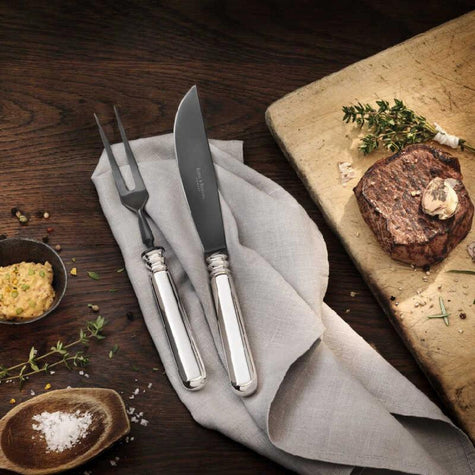


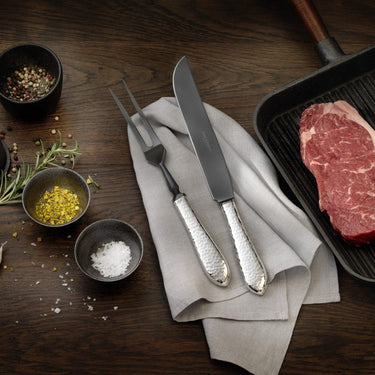
A meat carving fork is the tool that holds a joint steady while you carve — and choosing the right one makes the difference between clean, confident slices and a roast that slides around the board. Look for a fork with long, sturdy tines, a comfortable bolster, and a handle that feels secure in your grip.
Key Takeaways
- A good carving fork has tines at least 18 cm long, made from 18/10 stainless steel for strength and resistance to staining.
- The fork works as a clamp, not a lifter — press the tines into the meat to stabilise it, then carve alongside them.
- Carving sets sold as a pair (fork plus carving knife) are designed to balance each other in weight; buying them separately often results in a mismatched feel.
- At Lincoln House, we find the most common reason customers replace a carving fork is a snapped tine — a single-piece forged fork resists this far better than a welded one.
- Sterling silver and silver-plated handles are available for formal occasions; 18/10 stainless steel handles suit everyday and professional use.
What is a meat carving fork?
A meat carving fork is a two-tined kitchen tool used to hold a roast, bird or large joint in place during carving. Unlike a serving fork, which is shorter and broader, a carving fork has long, narrow tines — typically 15–22 cm — designed to pierce deep into the meat and grip it firmly. It's nearly always used alongside a carving knife as a matched set.
What should you look for when choosing a carving fork?
Tine length and shape
Tines of at least 18 cm give you enough depth to anchor a large joint — a leg of lamb or a whole rib of beef — without the fork shifting under pressure. Slightly curved tines grip more securely than perfectly straight ones. Avoid forks where the tines splay more than 3–4 cm apart at the tip; a tight gap concentrates the hold.
Handle material and balance
The handle should feel as substantial as the tines. A forged stainless steel handle with a full tang — meaning the metal runs the full length of the handle — distributes weight evenly and won't work loose over decades of use. For a formal table setting, a sterling silver or silver-plated handle brings an elegance that plain steel can't match, and partners beautifully with a silver-handled carving knife from the same pattern.
Forged versus stamped construction
A forged carving fork is pressed from a single billet of steel under high heat, producing a denser, stronger tine. A stamped fork is cut from a sheet of steel — lighter and cheaper, but prone to flex and, eventually, snapping at the base of the tine. For anything used regularly on large roasts, forged is the only sensible choice.
Matching your carving knife
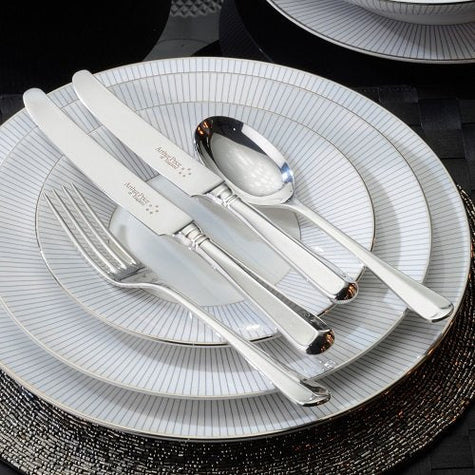
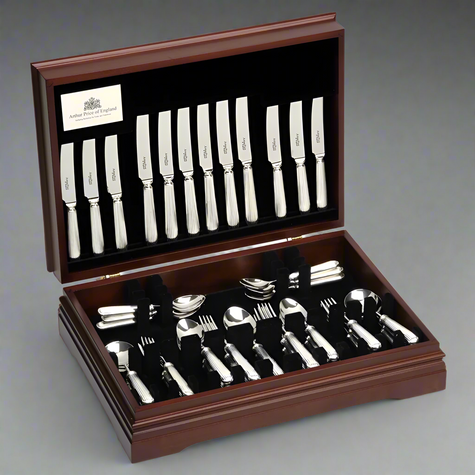
A carving fork works best when it's balanced against a knife of similar weight and handle dimensions. If you already own a carving knife from a specific pattern — say, Arthur Price's Old English range or a Studio William set — buying the matching fork from the same collection ensures the tools feel like a pair in use, not an accident.
Carving fork versus serving fork: what is the difference?
| Feature | Carving Fork | Serving Fork |
|---|---|---|
| Tine length | 15–22 cm | 8–12 cm |
| Tine spacing | Narrow (2–4 cm) | Broader |
| Primary use | Stabilising meat during carving | Transferring food to a plate |
| Guard/bolster | Usually present | Rarely present |
| Handle weight | Heavier, balanced to a carving knife | Lighter, part of a cutlery set |
A serving fork from your everyday cutlery set is not a substitute for a proper carving fork. The tines are too short and too widely set to hold a large joint steady.
How do you use a meat carving fork correctly?
- Rest the joint first. Allow the meat to rest off the heat for at least 15 minutes. Rested meat is firmer and holds its shape under the fork.
- Position the fork, not the knife. Set the fork first — tines pressed firmly into the thickest part of the joint, roughly 3–4 cm deep. The fork hand does the work of stabilising; the knife hand does the work of slicing.
- Keep the fork guard up. Most carving forks include a guard that folds up between the tines and the handle. Keep it raised so that if the knife slips, it deflects away from your hand.
- Carve alongside the tines, not through them. Run the knife parallel to the tines, not across them. This prevents the blade catching the fork and lets you produce even slices.
- Move the fork as you progress. Re-position the fork further into the joint as the carved section retreats. Never let the fork sit loose in already-carved meat.
- Clean and dry immediately after use. Even 18/10 stainless steel tines will mark if left in meat juices. Wipe clean, then wash and dry straight away.
How much should you spend on a carving fork?
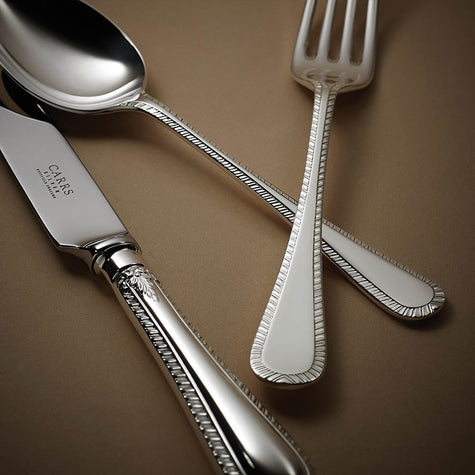
A sound, forged stainless steel carving fork starts at around £20–£35 for everyday use. A matched carving set — fork and knife together — from a maker such as Arthur Price or Elia typically runs from £45 to £120, depending on the pattern and finish. Silver-handled sets, including those with sterling silver handles from Carrs Silver, begin at around £150 and represent a genuine heirloom purchase.
Importantly, at Lincoln House we sell individual carving forks and matched sets across more than 300 patterns, so if you need to replace a fork that's been lost or broken without buying a whole set again, that's straightforward to arrange.
Frequently Asked Questions
Can I use a regular dinner fork instead of a carving fork? No. A dinner fork's tines are too short and too fragile to hold a large joint steady. It will bend under pressure and gives you no real control over the meat while you carve.
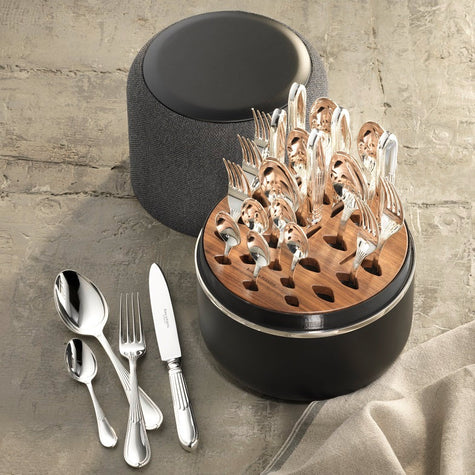
Does a carving fork need to match my everyday cutlery pattern? Not necessarily. Carving sets are often kept separate from the table setting. That said, if you're building a complete silver or stainless steel collection, matching the carving set to the table pattern creates a more cohesive look.
Is a carving fork dishwasher-safe? Forged stainless steel carving forks are generally dishwasher-safe, but silver-plated and sterling silver handles should be hand-washed to preserve the finish. Always check the maker's guidance — Lincoln House can advise on specific patterns.
How do I know if a carving fork tine is forged or stamped? Hold the fork and flex the tines gently. A forged tine has almost no give. A stamped tine will flex noticeably. You can also look at the base of the tine where it meets the bolster: forged construction shows a smooth, continuous transition, while stamped forks are often visibly welded or crimped.
What length of carving fork is best for poultry? For a chicken or duck, tines of 15–18 cm are ample. For a large turkey or goose, go to 20 cm or longer so you can anchor the bird securely without the fork pulling free as you carve through the breast.
