


Laguiole steak knives are so much more than just cutlery. They're a celebrated piece of French heritage, a beautiful blend of rustic history and elegant design that can truly elevate any meal. Known for their iconic bee emblem, slender shape, and handmade quality, these knives are a real investment in both function and art.
The Enduring Appeal of Laguiole Steak Knives
Picture a dining table where every single detail adds to the sense of occasion. The satisfying weight of the cutlery in your hand, the feel of the handle, the clean precision of the blade – it all plays a part. This is the world Laguiole steak knives belong to.
They aren't simply tools for cutting meat; they're symbols of a rich cultural history born in the French Aubrac mountains. To own a set is to appreciate centuries of tradition, skill, and artistry passed down through generations of master cutlers.
This guide is here to walk you through every aspect of these exceptional knives. We’ll explore their fascinating past, help you tell a genuine piece from the many imitations out there, and explain why a trusted specialist like Lincoln House Cutlery is your best bet for finding an authentic, heirloom-quality set.

More Than Just a Knife
So, what really sets Laguiole apart? It's that perfect marriage of practical design and meticulous hand-finishing. Every element, from the blade to the bolster, is carefully considered, creating a tool that feels perfectly balanced in the hand.
The experience of using a genuine Laguiole knife—gliding effortlessly through a steak without tearing the fibres—is worlds away from using a mass-produced alternative. It has the power to turn a simple meal into something far more refined.
Here are a few key things that define the Laguiole experience:
- Heritage and Story: Each knife carries the legacy of French craftsmanship, with designs that have evolved over nearly 200 years.
- Artisanal Quality: Unlike factory-stamped knives, authentic Laguiole pieces are often handcrafted by skilled artisans who have dedicated their lives to the trade.
- Iconic Aesthetics: The famous bee, the gentle curve of the handle, and the shepherd's cross are all hallmarks that tell a story of its origins.
- Superior Materials: From high-grade French steel to exotic woods and horn, the materials are chosen for both their beauty and their lasting performance.
A Journey into Craftsmanship
Consider this guide your definitive resource for understanding everything about these celebrated blades. By the time you're finished, you'll have a real appreciation for what makes Laguiole steak knives such a worthy addition to any discerning home or restaurant.
Think of it this way: just as a wine connoisseur appreciates the terroir and vintage of a fine wine, a cutlery enthusiast values the origin, materials, and maker of a Laguiole knife. It's about recognising the skill and history behind the object.
We’ll dive into the small details that separate a true masterpiece from a clever fake, making sure you can invest with confidence. From choosing the right blade steel and handle material to proper care and sharpening, you will gain all the knowledge you need to choose and maintain a set that can be passed down for generations.
Uncovering the History Behind the Blade
To really understand what makes a Laguiole knife so special, you need to go back in time. But we’re not heading to a fancy Parisian workshop; our journey takes us to the rugged, windswept highlands of the Aubrac plateau in southern France. The story of this iconic knife starts in the early 19th century, born from the daily life of local shepherds and farmers.

Before the Laguiole we know today, there was the ‘capuchadou’. This was a simple, fixed-blade tool with a bone or wood handle, and it was a shepherd’s best friend. They used it for everything, from slicing bread and cheese to tending their flocks. It was a tool of pure function, created out of necessity in a tough environment.
The design didn't stay static for long, though. Many men from the Aubrac region would travel to Catalonia in Spain for seasonal work. They brought back the Spanish ‘navaja’—a slim, folding pocket knife with a very distinct pointed tip. This Spanish influence was the spark that ignited a change.
Back home, local cutlers in the little village of Laguiole started blending the rustic utility of their capuchadou with the elegant, curved shape and folding design of the navaja. Around 1829, the first true folding Laguiole knife came into being, a perfect marriage of French practicality and Spanish style.
From a Farmer's Tool to a Symbol of Prestige
At first, this new folding knife was still very much a working man’s companion. It often came with an ‘alène’, a sharp spike used for punching holes in leather or as a trocar for helping livestock. This little detail really underscores its deep agricultural roots.
As its reputation grew, the design became more refined. Cutlers added a corkscrew around 1880, a clever response to the needs of café owners and waiters in Paris, many of whom came from the local Aveyron region. This one addition helped the knife transition from a rural tool to a versatile essential for city life.
The fame of Laguiole steak knives and pocket knives soon spread far beyond the Aubrac. The quality of the steel, the incredible skill of the artisans, and that unmistakable silhouette turned them into a symbol of French craftsmanship, desired across all of Europe.
The Legend of the Bee
Of all its features, none is more famous than the bee, or ‘mouche’ (fly), that sits on the spring where the blade joins the handle. Where it came from is a wonderful mix of folklore and historical debate.
- The Napoleonic Legend: The most romantic story claims Emperor Napoleon Bonaparte himself gave the village of Laguiole the right to use his imperial seal—the bee—as their emblem, a reward for the bravery of local soldiers.
- The Cutler's Terminology: A more down-to-earth explanation is that 'mouche' was simply an old knifemaking term for that part of the spring. The insect design was just a decorative touch that caught on and eventually became the standard.
- The Symbol of Longevity: Another idea is that the bee represents immortality and resurrection, a symbol chosen to reflect the knife's durability and to wish a long life for its owner.
Whatever its true origin, the bee has become the undisputed hallmark of genuine Laguiole cutlery. It captures the very spirit of the knife—a blend of Imperial legend, artisan tradition, and a deep connection to the French countryside.

Thiers: The Heartland of French Cutlery
While the knife's soul belongs to Laguiole, its story wouldn't be complete without mentioning the town of Thiers. For over 600 years, Thiers has been the beating heart of the French cutlery industry. When demand for Laguiole knives exploded in the early 20th century, many master artisans in Thiers began producing them, playing a huge role in their manufacture and global reach.
Today, however, the most respected workshops, like Forge de Laguiole, are proudly based back in the village of Laguiole itself, keeping that authentic link to its birthplace alive. This rich history—from a shepherd’s simple tool to an icon of design—is forged into every single blade, making each knife not just cutlery, but a real piece of French heritage.
How to Spot Authentic Laguiole Craftsmanship

Navigating the world of Laguiole steak knives can feel like a bit of a treasure hunt. With so many imitations flooding the market, how can you be sure you’re looking at a true piece of French heritage, not just a clever counterfeit? The first and most important thing to grasp is that ‘Laguiole’ is not a brand name or a trademark.
Instead, 'Laguiole' refers to a very specific style of knife with deep roots in the Aubrac region of France. Because the name itself isn't protected, anyone, anywhere, can legally produce a knife and label it a Laguiole. This makes it absolutely essential for buyers to learn the subtle but significant hallmarks of authentic craftsmanship.
This knowledge is your best tool. It allows you to invest with confidence, making sure you bring home a set of knives that embodies centuries of skill, not just a passing resemblance. The real quality, as always, is in the details.
Examine the Maker’s Mark and Origin
The single most reliable sign of an authentic knife is the maker’s mark, or ‘poinçon’, stamped clearly into the blade. Esteemed cutlers like Forge de Laguiole will always mark their work, proudly identifying its heritage.
Look for a crisp, clean stamp that names the maker and—crucially—its French origins. Mass-produced fakes often have a poorly etched, generic 'Laguiole' stamp, or sometimes no mark at all. A genuine knife tells you its story; an imitation hides its source.
The country of origin is non-negotiable. A genuine Laguiole knife must be made in France, almost always in the historic cutlery towns of Laguiole or Thiers. If the packaging or blade says 'Made in China' or anywhere else, it is not an authentic piece.
This is about more than just geographical pride; it’s a guarantee of quality materials and time-honoured techniques. UK imports of genuine French-made Laguiole steak knives have jumped by 25% since 2019, as discerning buyers increasingly sidestep the cheap, mass-produced fakes. Experts warn against sub-£10 imitations, noting that genuine pieces from makers like Jean Dubost can retain up to 85% of their resale value after five years—a true testament to their lasting quality.
Assess the Materials and Blade Quality
The materials tell a story all of their own. Authentic Laguiole steak knives are crafted from high-grade French or European steels, such as T10 stainless steel. These are chosen specifically for their durability, ability to hold a sharp edge, and resistance to corrosion.
A huge giveaway is the blade edge. While many imitations use serrated blades—they’re cheaper to produce and give a false sense of sharpness—true artisans almost exclusively prefer a non-serrated, straight-edge blade.
Why does this matter so much?
- A Clean Cut: A straight edge glides through meat, slicing the fibres cleanly without tearing. This preserves the texture and flavour of a good steak.
- A Sign of Quality Steel: A blade that can hold a razor-sharp straight edge is made from high-quality, properly tempered steel. Serrations can easily hide the use of inferior metal.
- Longevity: A non-serrated blade can be sharpened and maintained for a lifetime. A serrated edge, on the other hand, is almost impossible to resharpen properly.
Inspect the Fit and Finish
Finally, take the knife in your hand and have a close look at the overall finish. A handcrafted knife will show signs of meticulous, painstaking attention to detail.
Check the bolster, where the blade meets the handle. On a genuine knife, the transition will be smooth and seamless, with no gaps or rough edges. The handle scales should be perfectly fitted to the tang, and the pins holding them in place will be flush with the surface. Crucially, the bee emblem should be forged as part of the spring, not just glued on as an afterthought. These are the small but telling signs of a master cutler's work.
Choosing Your Blade Steel and Handle Material
The materials are the very soul of a Laguiole steak knife. From the gleam of the steel to the warm feel of the handle, these choices define its character, performance, and how it feels in your hand. Getting to grips with these options is the best way to find a set that's a perfect match for your taste and dining table.
It really all starts with the blade. This is where the knife’s purpose meets its long-standing tradition, and you generally have two paths to choose from. Each type of steel brings something different to the table, influencing everything from how you care for it to the way it ages over the years.
The Great Debate: Stainless Steel vs Carbon Steel
The blade is the business end of the knife, so the steel you choose is a critical decision. Authentic French artisans work with high-grade steels built for performance, but they offer quite different experiences for the owner.
-
Stainless Steel: For good reason, this is the modern standard. High-quality stainless steel, like the T10 French steel used by top makers, is brilliant at resisting rust and corrosion. This makes it incredibly durable and low-maintenance – a practical choice for everyday home dining or a busy restaurant. It holds a sharp edge beautifully and doesn't demand constant attention.
-
Carbon Steel: This is the purist's choice, for the true traditionalist. It’s famous for its ability to take on a razor-sharp edge, one that many connoisseurs feel is superior to stainless steel. But this incredible performance comes with a trade-off. Carbon steel is reactive and will develop its own unique patina over time – a handsome, dark grey oxidation. It needs looking after, requiring a quick wash and dry straight after use to keep rust at bay.
A carbon steel blade tells a story. Every meal adds to its character, creating a patina that is entirely unique to its owner. It's a commitment, but one that rewards you with unparalleled cutting performance and a deep connection to the knife's heritage.
A World of Handles: From Classic Wood to Polished Horn
Once you’ve settled on the blade, the handle is where you can really let your personal style shine. The artisans use a breathtaking variety of materials, and each one has its own texture, weight, and look. It's this choice that turns a functional tool into a small piece of art for your table.
The handle material has a huge impact on the knife's appearance and how it balances in your hand. Let's look at a few of the most popular options for Laguiole steak knives.
Comparing Common Laguiole Handle Materials
This table gives a quick overview of some favourite handle materials, helping you decide which might be the best fit for your needs.
| Material | Key Characteristics | Appearance | Best For |
|---|---|---|---|
| Olive Wood | Durable with natural antibacterial properties. | Warm, with beautiful, swirling golden-brown grain. | Those who appreciate a rustic, Mediterranean aesthetic. |
| Juniper Wood | Known for its distinct, aromatic peppery scent. | Light-coloured wood with intricate, dark knotting. | Someone seeking a sensory experience and unique look. |
| Horn Tip | A classic, luxurious material; each piece is unique. | Ranges from blonde to deep black, often with marbling. | Creating an elegant, traditional, and formal table setting. |
| Acrylic | Modern, durable, and available in various colours. | Sleek, uniform, and often vibrant in colour. | A contemporary dining space or for adding a pop of colour. |
Ultimately, choosing the right blade and handle is about striking a balance between practicality and personality. A stainless steel blade with a lovely olive wood handle gives you a fantastic blend of low-maintenance function and rustic charm. On the other hand, a carbon steel blade paired with a polished horn handle is the ultimate traditionalist's statement piece—it demands care, but the experience is second to none. By understanding these materials, you can choose a set of Laguiole steak knives that isn't just a tool, but a true expression of your style.
Selecting the Perfect Laguiole Steak Knife Set
Choosing the right set of Laguiole steak knives isn’t about finding a single "best" one. It's about finding the set that perfectly fits into your world. Whether you’re a home entertainer hosting dinner parties or a restaurateur running a busy establishment, the ideal set is the one that lines up with your style, your needs, and your expectations.
For the home cook, the decision is deeply personal, a blend of aesthetics and practicality. It’s a chance to pick something that not only performs brilliantly but also complements your dining room. Think about the handle materials we discussed earlier. Does the warm, rustic grain of olive wood suit your farmhouse table? Or would the sleek, polished finish of black horn be a better match for your formal dinners?
The size of the set is another key point. A standard set of six is perfect for most families and small gatherings. But if you often host larger parties, investing in a set of eight or twelve means you’re always prepared. These knives are more than just tools; they’re conversation starters, a tangible part of the dining experience you create.
Considerations For Home And Hospitality
When the knives move from a home kitchen to a professional hospitality setting, the priorities shift. Beauty is still important, of course, but durability and the guest experience really take centre stage.
For restaurant owners and hoteliers, a Laguiole steak knife is an investment in creating a memorable meal. It’s one of those small details that signals quality and a real commitment to excellence.
- Durability is Paramount: Knives in a commercial setting face constant use and washing. Stainless steel blades are the industry standard for a reason – they resist corrosion and are easy to maintain. For handles, resilient materials like stabilised wood or high-grade acrylic can withstand the rigours of a professional kitchen far better than their untreated counterparts.
- Performance and Guest Experience: The knife has to perform flawlessly, every single time. A sharp, well-balanced blade that glides through a steak enhances the diner's enjoyment and elevates their perception of the entire meal.
- Brand Consistency: The style you choose should match the restaurant's brand, whether that’s rustic charm or modern elegance. The right knife reinforces the story you're telling.
Serrated or Non-Serrated Blades
One of the most practical decisions you'll make is choosing between a serrated and a non-serrated blade. While many mass-produced steak knives you see are serrated, connoisseurs and traditional artisans almost universally favour a straight, smooth edge.
There's a good reason for this. A non-serrated blade slices cleanly through meat fibres, preserving the texture and all the precious juices of a perfectly cooked steak. It’s a mark of quality steel, as only a superior metal can hold such a fine, razor-sharp edge. A serrated knife, on the other hand, tears and rips the fibres, which can really diminish the meat's texture.
While non-serrated blades do need a bit of sharpening now and then to keep them at their best, this small act of maintenance ensures a superior cut for a lifetime.
The infographic below can help you visualise whether a more traditional or modern approach is right for you.
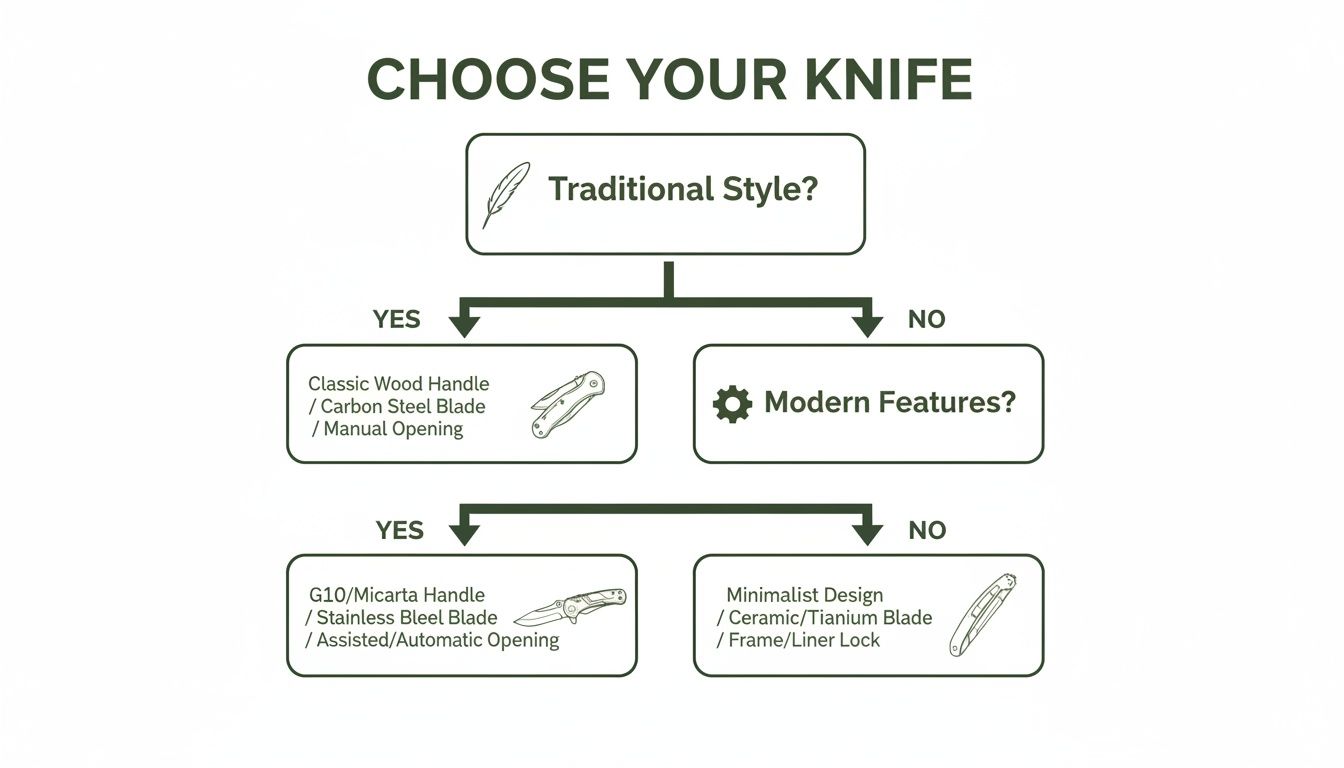
This decision tree shows how your own personal preference, whether for classic aesthetics or modern functionality, can guide your choice in both blade and handle materials.
Finally, think about storage. A quality set of Laguiole steak knives deserves to be properly protected. Many sets come in an elegant wooden case or box, which not only looks beautiful but also protects the blades from knocking against other utensils, keeping them sharp and pristine for years to come.
Preserving Your Knives for a Lifetime of Use
A beautiful set of Laguiole steak knives isn't just a purchase; it's an investment in artistry and performance. These knives are crafted to last a lifetime, and even be passed down through generations. A little bit of simple, consistent care is all it takes to keep them looking and feeling as wonderful as the day you first held them.
Looking after your knives properly protects the natural materials of the handle and preserves that razor-sharp edge, ensuring they'll serve you beautifully for years to come.
The most important rule is also the simplest: never, ever put your Laguiole knives in the dishwasher. The combination of intense heat, aggressive detergents, and soaking in water is the enemy of natural materials like wood, horn, or bone.
A dishwasher cycle will wreak havoc on these organic handles, causing them to:
- Dry out and crack: The heat strips away the natural oils, leaving wood brittle and prone to damage.
- Warp and split: Wood and horn can swell with moisture and then shrink unevenly as they dry, causing permanent splits.
- Fade and lose their lustre: The vibrant colours and intricate patterns that make each handle unique can quickly become dull and lifeless.
Even the blade itself isn't safe. It can be blunted or marked by knocking against other items in the machine. Hand-washing is the only way to go to preserve the integrity and beauty of your knives.
The Correct Way to Clean Your Knives
The right cleaning method is quick, easy, and ensures your knives are ready for their next meal without risking any harm.
- Wash Promptly: As soon as you've finished your meal, wash the knives by hand with a soft cloth or sponge, using warm water and a little mild washing-up liquid.
- Don't Soak: Never leave your knives to soak in the sink. The longer they're submerged in water, the more damage it can do to the handles.
- Dry Immediately: This is the most crucial step. As soon as you've washed them, dry each knife completely with a soft, clean tea towel. Make sure to dry the area where the blade meets the handle.
A good way to think about it is to treat your Laguiole knives like a piece of fine wooden furniture or a cherished leather-bound book. You wouldn't subject them to harsh conditions, and these handcrafted tools deserve the same level of respect. A little care really does go a long way.
Keeping the Handle and Blade in Top Condition
Beyond the daily clean, a few extra touches will keep your knives in peak condition. For wooden handles, like those made from olive or juniper, it's a great idea to occasionally treat them with a food-safe mineral oil or beeswax polish. Just apply a small amount with a cloth, let it soak in for a few minutes, and then buff off any excess. This simple act nourishes the wood, stops it from drying out, and brings out the beauty of its natural grain.
To keep the blade performing at its best, a regular once-over with a sharpening steel will maintain its edge between professional sharpenings. For a non-serrated blade, this keeps the edge perfectly aligned for that effortless, clean cut Laguiole steak knives are famous for. This commitment to care is rewarded with remarkable durability. It's something we see in customer feedback all the time, with 92% satisfaction rates for olive wood-handled sets. Their 2.5mm thick carbon stainless steel blades are often praised for outlasting standard knives by 40% in sharpness retention.
Your Laguiole Questions Answered
Even after delving into the rich history and fine details of Laguiole steak knives, you might still have a few things you're curious about. This last section tackles the most common queries we hear, giving you clear, straightforward answers to help you feel completely confident about these remarkable knives.
Are All Laguiole Steak Knives Made in France?
Not necessarily, and this is a really important point for any potential buyer. The name 'Laguiole' refers to a style of knife, not a protected trademark like Champagne. This means, legally, a knife can be made anywhere in the world and still carry the Laguiole name.
However, any authentic, high-quality Laguiole knife is always made in France, hailing from the historic knifemaking towns of Laguiole and Thiers. Esteemed makers like Forge de Laguiole and Laguiole en Aubrac guarantee a true French origin. To ensure every knife we sell is a genuine piece of French heritage, we only source from these master artisans.
What Is the Significance of the Bee on the Knife?
That little bee, or mouche (fly), you see on the spine of the knife where the handle meets the blade is the iconic Laguiole emblem. Its origins are a wonderful mix of legend and history. The most romantic story links it to Napoleon Bonaparte, who is said to have allowed the village of Laguiole to use his imperial seal as a reward for their courage.
A more down-to-earth explanation is that it's simply a stylised fly, which was a common decorative feature in historical knifemaking. Whatever its true origin, the bee has become the most recognisable symbol of Laguiole craftsmanship and a hallmark of quality.
Think of the bee as the maker's signature flourish. While its story may be debated, its presence has become synonymous with the authentic Laguiole style, representing a tradition of excellence passed down through generations of cutlers.
Can I Put My Laguiole Steak Knives in the Dishwasher?
We strongly advise against it, especially for knives with natural handles made from wood, horn, or bone. The combination of intense heat, harsh detergents, and soaking in water can cause real, irreversible damage.
This hostile environment will make handles crack, warp, or lose their beautiful lustre. To keep them looking their best for a lifetime, always wash your Laguiole knives by hand using mild soap and warm water. Just as importantly, dry them straight away before putting them away.
Should I Choose a Serrated or Non-Serrated Blade?
This really comes down to personal preference and how you feel about maintenance. Serrated blades are very low-maintenance—they rarely need sharpening and are great for getting through crusty meats. The downside is that when they do eventually go blunt, they are incredibly difficult to sharpen properly.
A non-serrated, straight-edged blade is the choice of chefs and purists for one simple reason: it gives a much cleaner cut. It glides through meat without tearing the fibres, which helps keep the juices and texture of a perfect steak just right. While these blades do need regular honing to keep them at their best, they are much easier to sharpen, promising a lifetime of superior performance.
Ready to experience the elegance and precision of authentic French craftsmanship? Explore our curated collection at Lincoln House Cutlery and find the perfect set of Laguiole steak knives to elevate your dining table. Discover our full range here.
